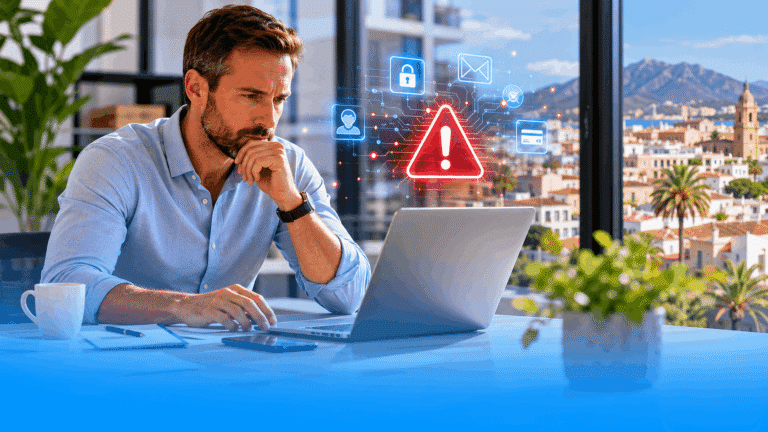
Cyber attacks in Spain are no longer limited to banks, technology companies or large corporations. Small businesses, professional firms, shops, clinics, manufacturers, hospitality businesses and international entrepreneurs are increasingly exposed to online fraud, phishing, data theft and system interruption. For expats running a business in Spain, the risk can feel even more difficult to manage because the language, regulations, insurers and claims process may be unfamiliar. Spain’s National Cybersecurity Institute, INCIBE, reported 122,223 cybersecurity incidents managed in 2025, 26% more than the previous year, with online fraud and phishing among the most frequent threats.
This article explains why cyber risk is spreading across sectors, what businesses in Spain should watch for, and how cyber insurance can help protect your company, clients and reputation.
.
.
.
Why cyber attacks in Spain now affect every sector
For many years, cyber risk was seen as a problem for banks, payment platforms, technology providers and large companies with complex digital systems. That view is now outdated. Today, almost every business depends on email, online banking, cloud platforms, client databases, booking systems, supplier portals or digital payment tools. That means almost every business has something a cyber criminal can exploit.
INCIBE reported that online fraud accounted for 45,445 cases in 2025, 19% more than in 2024, while phishing reached 25,133 incidents. These numbers matter because phishing and online fraud are not highly technical problems from the victim’s perspective. They often begin with a convincing email, a fake invoice, a false supplier message, a cloned login page or a fraudulent payment request.
For an expat entrepreneur in Spain, the risk can be even more stressful. You may be managing clients in several countries, working in English while receiving documents in Spanish, relying on external accountants or agencies, and operating with a lean team. A single mistake can create a chain reaction affecting payments, customer data, service delivery and trust.
A British business owner in Málaga recently told us that she assumed cyber insurance was only relevant for companies with large IT departments. After reviewing her business, she realised that her client database, online payment system and email account were all essential to daily operations. C1 Broker helped her compare cyber insurance options and understand what type of protection matched her real exposure. She left the conversation feeling less overwhelmed and more in control.
.
.
.
The real business risk behind phishing, fraud and data theft
Cyber crime is often described with technical language, but the real impact is very practical. A cyber incident can stop a business from working, prevent access to files, expose customer information, create legal obligations, damage reputation and generate unexpected recovery costs.
.
Phishing and fake payment requests
Phishing remains one of the most common threats because it targets people, not just systems. A fraudulent email may look like it comes from a bank, supplier, delivery company, tax authority or software provider. For foreign business owners in Spain, these messages can be particularly convincing when they include Spanish terminology, official looking logos or urgent language.
The danger is not only clicking a bad link. It may involve transferring money to a false account, revealing login details, authorising a fake invoice or giving access to sensitive information.
.
Ransomware and system interruption
A ransomware attack can block access to files, software, booking systems, accounting platforms or customer records. Even a small company can suffer serious losses if it cannot issue invoices, manage appointments, contact clients or deliver services for several days.
For companies with international clients, interruption can also damage confidence. Customers may not care whether the problem came from a hacker, software failure or human error. They simply see that the business cannot operate normally.
.
Data breaches and client trust
If personal data is stolen, exposed or accessed without authorisation, the issue can become more than a technical problem. Companies may need to follow data protection procedures and communicate with affected clients. In Spain, businesses must take data protection seriously, especially when they store names, addresses, identity documents, payment details, medical information or professional records.
This is where cyber insurance becomes more than a financial product. The right policy can help provide access to specialist support, technical response and guidance at a moment when the business owner may not know what to do first.
.
.
.
Why expat business owners in Spain should pay special attention
Running a business abroad is rewarding, but it also creates additional layers of uncertainty. You may understand your product, your clients and your market very well, but Spanish insurance wording, cyber incident response, legal procedures and insurer requirements may be harder to interpret.
Many expat business owners also work across borders. A consultant in Valencia may serve clients in Germany, the Netherlands and the UK. A property manager on the Costa del Sol may hold passport copies, rental contracts, payment details and owner records. A clinic, school, hotel or professional office may store highly sensitive personal information. The more connected the business is, the more important it becomes to protect its digital operations.
One Dutch client managing holiday properties in Alicante asked us whether cyber insurance was necessary because his company did not “sell technology”. After looking at his activity, the real issue was clear: he handled owner data, guest details, online bookings, card payments and supplier communications every day. C1 Broker helped him understand that cyber cover was not about being a technology company. It was about protecting the systems that allowed his business to function.
.
.
.
What cyber insurance in Spain can help cover
Cyber insurance is designed to protect companies against the financial and operational consequences of digital incidents. The exact cover depends on the insurer and policy, which is why comparing options carefully is essential.
A cyber insurance policy may include protection for situations such as hacking, ransomware, data theft, damaged software, cyber extortion, fraudulent access, business interruption and specialist incident response. C1 Broker’s cyber insurance page explains that this type of cover can help when a hacker enters your system, blocks files, damages software or steals customer data.
The important point is that not all policies are the same. Some focus more on recovery costs, others on liability, business interruption, cyber extortion, legal support or technical assistance. A company that sells online has different needs from a professional consultant, a property agency, a manufacturer or a medical practice.
.
.
.
Authority reference: what Spain’s cybersecurity data tells us
The official figures from INCIBE show that cyber risk in Spain is growing and becoming more diverse. In 2025, INCIBE managed 122,223 cybersecurity incidents, a 26% increase on the previous year. Online fraud represented 45,445 cases, and phishing remained one of the most frequent methods used by attackers.
This confirms a key point for business owners: cyber risk is not theoretical. It is already affecting companies, institutions and individuals across Spain. The lesson is not to panic, but to prepare. A good cyber protection strategy usually combines practical prevention, staff awareness, secure systems, backups, clear procedures and suitable insurance.
.
.
.
Practical steps before choosing cyber insurance
Before taking out cyber insurance in Spain, businesses should understand their exposure. This does not require you to become a cybersecurity expert, but it does require clear thinking about how your company works.
You should consider what data you store, how you receive payments, whether your team uses shared email accounts, how backups are managed, which software platforms are essential, and how long your business could operate if systems were blocked. You should also think about who would help you in the first 24 hours after an incident.
For expats, one of the most useful steps is speaking with an English speaking broker who can explain policy wording clearly. Cyber insurance can include technical terms, exclusions, conditions and response procedures that are not always obvious. Choosing quickly based only on price can leave dangerous gaps.
An American consultant in Madrid shared that her biggest fear was not only losing money, but not knowing who to call if her client files were compromised. C1 Broker helped her compare policies with incident response support and clarify what would happen after a claim. For her, the value was not just the cover itself, but knowing there was a plan.
.
.
.
Why working with a specialist broker matters
Cyber insurance is not a product you should choose blindly. Two businesses may both say they need “cyber cover”, but their risks can be completely different. A restaurant with online bookings, a law firm with confidential documents, an ecommerce store, a property agency and a self employed consultant all face different exposures.
This is where a specialist broker like C1 Broker makes a real difference. C1 Broker does not simply sell a policy. We compare, study and research for you. We help you understand the product, identify the risks that matter to your business, compare insurance companies, review exclusions and choose cover that fits your situation.
For expats, this guidance is especially valuable because you may be dealing with unfamiliar Spanish systems, documents and terminology. C1 Broker offers English speaking support and practical advice so you can make decisions with confidence, not confusion. The objective is simple: to help you protect your business, your clients and your peace of mind with less hassle.
.
.
.
Conclusion
Cyber attacks in Spain are increasing, and the risk now reaches far beyond banks and technology companies. Online fraud, phishing, ransomware and data theft can affect almost any business that depends on email, digital payments, customer records or online systems. For expat entrepreneurs and foreign business owners in Spain, the challenge is not only technical. It is also linguistic, legal, operational and emotional.
The right cyber insurance can help reduce the financial and practical impact of a cyber incident, but choosing the right cover requires careful comparison. Working with a specialist broker gives you clarity, guidance and support before problems happen.
.
.
.
If you run a business in Spain and want to understand whether cyber insurance is right for you, contact C1 Broker today. Our team will help you compare options, understand the cover and find a tailored solution for your company. Fill in the contact form and get professional advice in English with no hassle. Know more about our Cyber Insurance Solutions here!
.
.
.
FAQs
Is cyber insurance necessary for small businesses in Spain?
Yes, many small businesses are exposed to cyber risk because they use email, online banking, customer databases, booking systems or digital payments. Cyber insurance can help protect against the financial and operational impact of incidents such as phishing, hacking or data theft.
.
Does cyber insurance cover phishing attacks?
Some cyber insurance policies may include protection related to phishing, fraud, data compromise or business interruption, depending on the insurer and policy conditions. It is important to review the wording carefully with a broker before choosing cover.
.
Is cyber insurance only for technology companies?
No. Cyber insurance can be useful for many sectors, including property services, consulting, retail, hospitality, healthcare, ecommerce, manufacturing and professional services. The key question is how dependent your business is on digital systems and client data.
.
Can C1 Broker help expat business owners compare cyber insurance in Spain?
Yes. C1 Broker helps expat business owners understand cyber insurance, compare insurers, review exclusions and choose cover adapted to their company’s needs.
.